/ The Brand Strategy Canvas
Anyone can ship software. Not everyone can create meaning.
The tools to ship have never been more powerful. The market has never been more crowded. Speed-to-market is table stakes. But what still can't be LLMed is the strategic insight that makes a brand resonate. Ten boxes. One page. This is the framework for finding it.
/ The Problem
Building is cheap. Meaning is earned.
Coding agents mean any team can ship fast. That's raised the floor — and the ceiling — of what's possible. It's also flooded every market with countless alternatives.
When the tools to build are everywhere, what separates the companies that break through is clarity: about who they're for, what they genuinely offer, and why it matters. That clarity can't be generated. It has to be discovered by a human willing to do the strategic work.
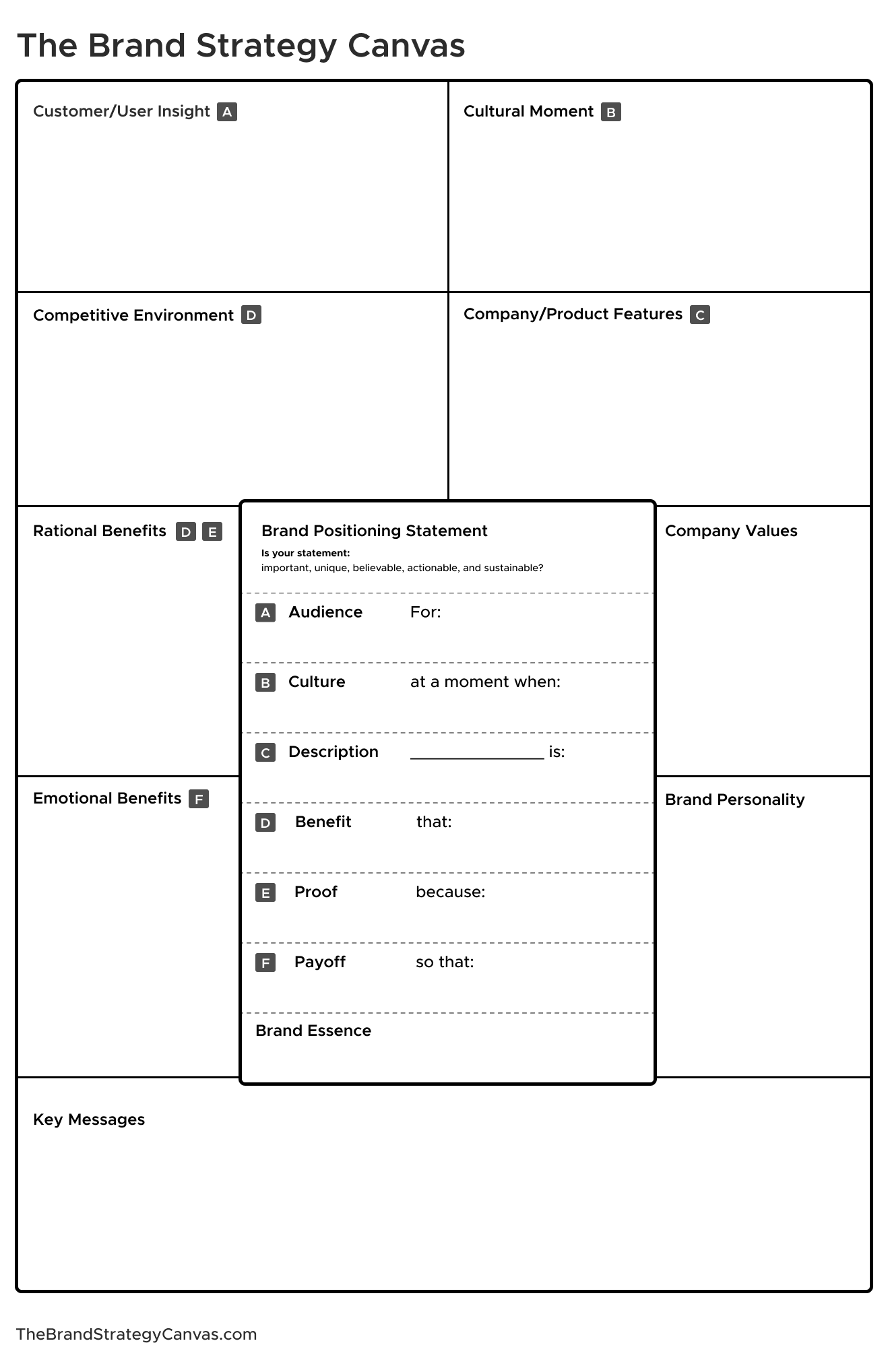
The Brand Strategy Canvas is that work. Ten boxes. In order. The framework for turning your insight about your audience, your market, and your product into a brand strategy that actually holds.
/ The Framework
Ten boxes. One strategy.
Each box builds on the last. Fill them in order for a clear point of view on who you're for, what you stand for, and why you win.
/ How It Works
Four sections. Ten decisions. One foundation.
Work through them in order. Each answer narrows the decision space for what comes next — copy, design, positioning, hiring. Done right, you'll reference this for years.
Section 01
Market Opportunity
Boxes A, B, C, D
Customer / User Insight
A precise portrait of who you're building for — not a demographic checkbox, but a real understanding of how they think, what they fear, and what they're trying to become.
Cultural Moment
What's shifting in culture, technology, or the market that makes this brand timely right now. The "why now" that separates a brand that feels prescient from one that feels generic. The most dynamic box on the canvas — revisit it as the moment evolves.
Competitive Environment
Map the landscape: what alternatives exist, how they position themselves, and where the white space is. The anti-audience exercise clarifies who you're explicitly not for.
Company / Product Features
What your product actually does. This is the raw material — before benefits, before emotion, before story.
Section 02
Benefits
Rational + Emotional
Rational Benefits
How customers experience your features — not what it does, but what it means for them. The first step up the Ladder of Abstraction.
Emotional Benefits
The higher-order payoff. This is where most startups stop — which is exactly why it's the biggest differentiation opportunity on the canvas.
Section 03
Positioning
Statement + Essence
Positioning Statement
One sentence. Who you're for, what you offer, why it matters. Every box above this one exists to make this sentence true.
Brand Essence
2–4 words that distill the whole statement. Short enough to remember. Clear enough to make decisions from.
Section 04
Voice & Expression
Values, Personality, Key Messages
Values
Internal guide rails, not marketing copy. The nouns that describe what your company genuinely believes and how it makes decisions.
Personality
How your brand shows up in the world. Characterful, not generic. The outward expression of everything your values say internally.
Key Messages
3–5 concepts you communicate consistently, each backed by proof points. Apply the Talk Like a Human test before you're done.
/ Claude Code Plugin
The framework, built into Claude Code.
Install the plugin, run /brand-canvas, and Claude walks you through every box — asking the right questions, pushing back on vague answers, and writing your finished canvas to file when you're done.
It knows where you are. Start fresh, pick up mid-canvas, or jump straight to a specific section. You finish with two files: a full strategic document and an Excalidraw diagram you can pin to the wall.
# Install the plugin
$ /plugin marketplace add patrickjwoods/brand-canvas-plugin
$ /plugin install brand-canvas@patrickjwoods/brand-canvas-plugin
# Start your canvas
$ /brand-canvas
# Or jump to a section
/brand-canvas opportunity → Market Opportunity
/brand-canvas benefits → Rational & Emotional
/brand-canvas position → Positioning Statement
/brand-canvas voice → Values, Personality, Messages